Prime rib just screams the holidays. It’s always been a family tradition of mine to make prime rib for Christmas Eve, and it’s always the food highlight of my year. The meal I dream about all year round. Even so, I decided I was going to kick it up a notch. I was going to master the prime rib and make an unrivaled roast that my family and guests would rave about for years to come.
Sous-vide cooking transforms prime rib into a reliably tender, juicy roast that’s pink edge-to-edge with minimal effort. With a bath at 56 °C / 133 °F for 8 hours, this method gently breaks down collagen for melt-in-your-mouth texture while preserving a consistent rosy doneness.
The result: a roast that slices beautifully and stays juicy, with a rich crust after a quick high-heat sear. Whether you’re cooking for a holiday feast or a special dinner, this sous vide prime rib delivers restaurant-quality results with less stress and more control.
At a Glance
- Cut: Standing rib roast / Prime Rib
- Temperature: 56 °C / 133 °F
- Cook Time: 8 hours
- Finish: Sear at high heat (oven broil 475 °F / 245 °C for ~15 min) with herb-butter crust
- Notes: Consistent edge-to-edge medium-rare, melty internal texture, herbed butter crust for flavor boost
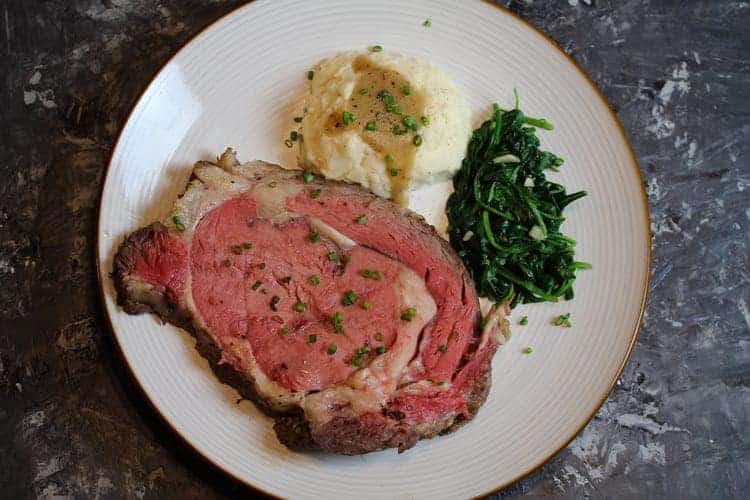
Deciding that I was going to sous vide the prime rib was easy. It is truly the only way to guarantee the meat is tender, juicy and perfectly cooked all the way through. Deciding how to season the prime rib was a little more difficult.
After some experimentation and test runs, I finally figured it out. I created salty, garlicky and herbaceous compound butter that perfectly compliments the flavor profile of the prime rib. This butter compound is all the salt and flavor the prime rib needs for epic taste.
Furthermore, coating the roast in this butter amplifies the Malliard reaction in the oven, which creates a picture-worthy sear.
Add sous vide prime rib and garlic herb compound butter together and you have a fool-proof method of making unforgettable prime rib. Now take this knowledge and become the prime rib master that will be cherished by your family and guests for many moons.
Why Sous Vide Prime Rib
Using the precise temperature control of sous vide ensures even cooking throughout the roast — from edge to center — eliminating the common problem of overcooked outer layers and undercooked interior.
Low-temperature, long-time cooking gently melts connective tissue into gelatin, resulting in a tender, juicy texture that conventional roasting often struggles to achieve with such consistency.
That consistent medium-rare doneness and moisture retention make sous-vide prime rib a top option for special occasions and holiday dinners, where presentation and flavor matter.
To French or Not to French
“Frenching” is a culinary technique that involves exposing the rib bones by cutting off meat and fat from the bone side of a roast. Frenching is generally used to beautify a dish and make it look fancier.
However, for this recipe frenching makes sense since you are trimming away excess fat in advance that you would end up cutting off later. Plus the prime rib looks absolutely stunning frenched.
If you want to be adventurous and learn a new skill, try frenching the prime rib yourself at home. Just make sure your knife is real sharp so you can effortlessly carve this heavenly piece of meat. I recommend the E5 electric knife sharpener for the job.
If frenching isn’t for you, just ask your butcher and they will be happy to do it for you.
If you’re planning a special occasion or Valentine’s dinner, we’ve put together a complete stress-free sous-vide Valentine’s guide with menu ideas and timing tips.
Packaging
An essential part of cooking sous vide is putting ingredients in an air-tight bag or container. The two most common techniques to package your ingredients are vacuum sealing and using the water displacement method.
A vacuum sealer removes all the air and seals the contents of a plastic bag through a vacuum. Ensuring the food is airtight and properly sealed prevents the bag from floating, which can result in uneven cooking.
The displacement method is a technique where you first place your food and marinades in a sous vide bag, submerge the bag in a container of water, and allow the pressure to force all the air out of the bag.
Both of these methods work for this recipe, so use whichever you feel more comfortable with!
Sous Vide Cooking Step
Preheat your sous vide bath to 56 °C / 133 °F.
Place the seasoned prime rib in the bag and seal it (vacuum or displacement). Submerge fully in the water bath.
Cook for 8 hours. That time is sufficient to break down collagen and deliver a tender roast with a consistent rosy doneness throughout.
Time and Temperature
We found that cooking the rib roast at 56C/133F for 8 hours is the perfect combination. Leaving the roast in for 8 hours breaks down the connective tissue (collagen), which results in an extremely tender roast. Also, cooking it at a temperature of 133F is the sweet spot for that perfect edge-to-edge beautiful rosy color.
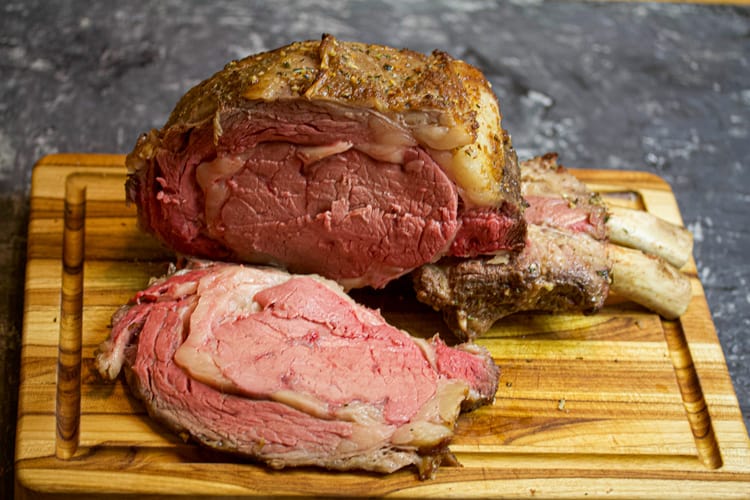
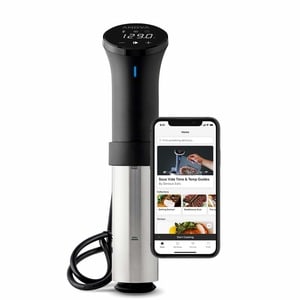
Just make sure you have a reliable sous vide that accurately regulates the temperature of the bath or your results may vary (check out the Anova or Joule). If you want to explore other time and temperature options, check out our cooking guide here.
Placing Roast in an Ice Bath
Once the prime rib is finished cooking in the sous vide, I recommend immediately transferring it to an ice bath. An ice bath is the term for a big bowl or cooler filled with ice and water.
Placing the standing rib roast in the ice bath for 10 minutes will cool down the external temperature and make it easy to spread the butter compound. If the external temperature is not cooled, the butter will instantly melt.
Alternatively you can cool the prime rib in the refrigerator for 20-30 minutes, or until the external temperature is chilled.
Finishing the Prime Rib- The Crucial Step to A Great Crust!
Searing is the most critical step in the sous vide process. Getting a deep, rich sear can make your food look like it is Michelin star quality. Failing to do so will make your dinner guests wonder why they let you cook again.
If you want to get an amazing sear on your rib roast, you’ve got to:
1. Pat your meat completely dry
2. Coat generously with compound butter
3. Finish at high temps to achieve a deep, rich sear
Applying Compound Butter
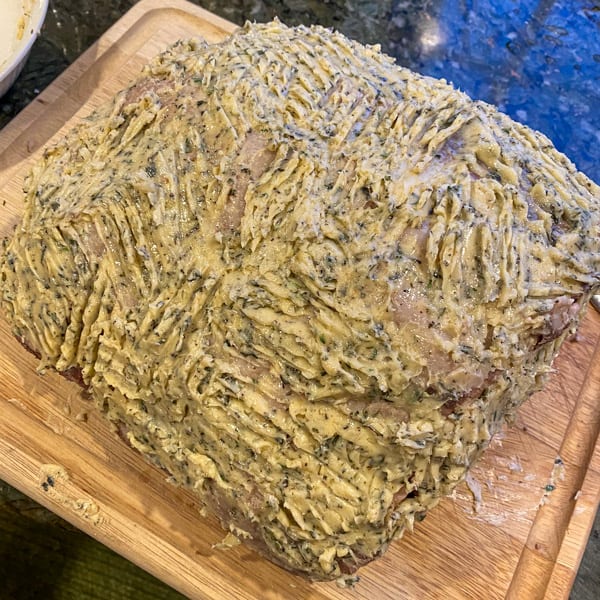
First, pat the meat completely dry using paper towels. After the meat is dry, coat the roast generously with the compound butter. The most effective way to spread the butter evenly on the rib roast is with fork or a silicon spatula.
Note that the external temperature of the prime rib needs to be cool to properly apply butter. Please drop the roast in an ice bath or chill in a refrigerator until chilled prior to applying the butter.
Seasoning & Herb-Butter Flavor Boost
Generously season the roast with salt and pepper before sealing. A simple compound butter — softened unsalted butter mixed with garlic, chopped rosemary, thyme, salt and seasoning salt — adds savory depth and helps build a rich crust.
Searing the Roast
Last, cook the prime rib at high temperatures to achieve a deep, rich sear. We suggest baking the roast in the oven at 475F for 15 minutes.
This high temperature ensures the butter will melt quick, which amplifies the Malliard reaction and results in a nice crust. Also 15 minutes will make sure the internal temperature of the roast is at serving temperature.
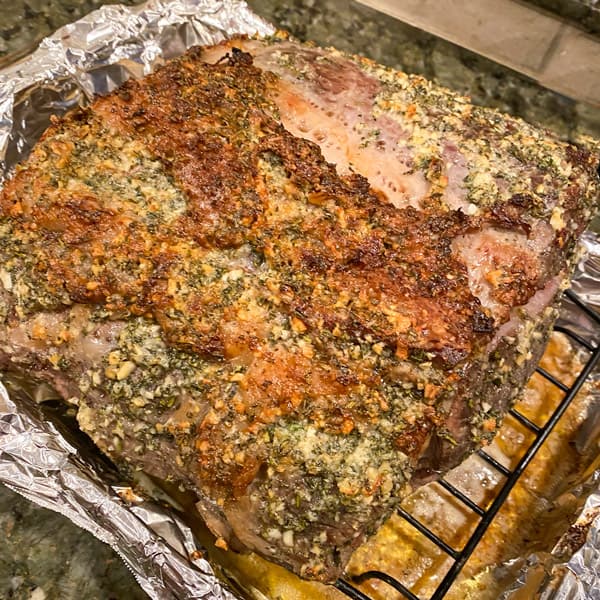
Equipment & Preparation Tips
Use a large vacuum bag (or freezer-quality bag) that fits your roast. Vacuum seal it or use water displacement to remove air.
A large container (e.g. 12-quart plastic box) helps ensure the roast stays submerged. A lid or cover reduces evaporation during long cooks.
If using a bone-in roast, some cooks choose to ask their butcher to “french” the bones (i.e. trim fat and expose bones) for easier trimming and more elegant presentation — but it is optional.
Special Equipment
Sous Vide Machine – This one is obvious. To cook sous vide, you’re going to need a device to precisely regulate the temperature of the bath water. The two best sous vide machines in the game right now are the Anova Precision Cooker and the Breville Joule.
The main difference between the two is that with the Anova you can control the device both manually and with a mobile device, and with the Joule you can only control the device by using your mobile device. Either way, both sous vide machines are top class and you can’t go wrong with either choice.
12-quart Container – Although you can use a basic stockpot for your sous vide cooking needs, I highly recommend buying a large plastic container. They are inexpensive and spacious, so you won’t have to worry about cooking a big roast in a small pot. I recommend a 12 quart Rubbermaid container, as it is BPA free, sturdy, and large enough for just about anything you will be cooking.
Container Lid – If you are going to buy a plastic container, I highly suggest buying a compatible lid for it. When you sous vide for a long duration, the heat of the water causes evaporation. With a lid, it eliminates a majority of the evaporation so you can cook for hours care-free.
FoodSaver Rolls – Finding a bag that can fit a big rib roast is not an easy feat. The best solution we found was to use the FoodSaver Expandable Rolls.
Roasting Pan and Rack – Having a quality roasting pan for this recipe can help achieve an excellent sear in the oven. We use this stainless steel roasting pan because it’s perfect for larger roasts like prime rib roasts and turkey, and it comes with both a flat roasting rack and a V-shaped rack for flexibility.
Next Level Sous Vide –Looking to take your sous vide skills to the next level? The Next Level Sous Vide eCookbook will push your culinary boundaries with 65 delicious recipes that are equally approachable and tasty. With pro tips and a detailed explanation of the sous vide process, you will be on your way to maximize your sous vide skills.
Check out our full list of recommended gear here.
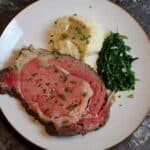
Sous Vide Prime Rib Roast
Ingredients
- 5 -7 lb prime rib roast
- 1 cup unsalted butter, softened
- 6 cloves garlic, minced
- 2 tablespoon fresh rosemary, chopped
- 2 tablespoon fresh thyme, chopped
- 1 tablespoon salt
- 1 tablespoon Lawry's seasoning salt
- 1 tablespoon black pepper
Instructions
Preparation
Set sous vide machine to 56C/133F.
Salt the rib roast to taste. Put the roast in a freezer bag, and remove the air through a vacuum sealer or the displacement method. Drop prime rib in the bath for 8 hours.
Finishing
Mix together softened butter, garlic, rosemary, thyme, salt and Lawry's seasoning salt together in a bowl until the compound butter is spreadable.
Remove bag from bath and immediate transfer the roast into an ice bath Let t.he roast chill for 10 minutes. Remove bag from ice bath, take rib roast out of the bag and thoroughly pat dry.
Preheat oven for 475F. Evenly coat garlic herbed compound butter on the entire prime rib. Place rib roast on a baking rack pan and cook for 15 minutes. Check with a meat thermometer to ensure that the internal temperature is 110F or your desired serving temperature.
Remove rib roast from oven. Let rest for 5 minutes. If it is a bone-in roast, carefully carve off the bones making sure not to cut into the roast. Carve the prime rib into slabs and enjoy this heavenly piece of meat. *Pro tip - brush the excess butter and garlic mixture from the pan onto each piece before serving.
Troubleshooting & Adjustments
Smaller or larger roasts: The original recipe suggests 8 hours works for 5–7 lb roasts.
If roast is smaller than ~4 lb, you might consider reducing sous-vide time (e.g. 5–6 hours) — a smaller mass will heat through faster.
If roast is much larger, some increase cook time to 10–12 hours for even cooking; but extended time beyond tenderizing gives diminishing returns.
Bag floating / uneven heat contact: Ensure bag is tightly sealed and submerged; using a heavy clip, weights or suitable container helps prevent floating. This ensures even cooking and safety.
Why This Method Works (Science Behind It)
Sous vide cooking uses controlled temperature below traditional roasting heat, which prevents outer layers from overcooking while allowing even heat penetration. This results in uniform doneness throughout.
At these lower temperatures over a long duration, collagen in the meat’s connective tissue gradually converts to gelatin, giving moisture retention and tender, almost buttery texture — something difficult to replicate with standard high-heat roasting.
Adding a final high-heat sear with herb butter combines the best of both worlds: internal tenderness and rich, flavorful crust like a classic roast.
FAQs
Q: Can I sous-vide a larger prime rib roast (e.g. 10–12 lb)?
A: Yes. Many sous-vide cooks extend the cook time to 10–12 hours for larger roasts to ensure even heat penetration while still achieving tender, juicy meat.
Q: What if I’m cooking a smaller roast (under 4 lb)?
A: For smaller cuts, reducing the sous-vide time to around 5–6 hours can be sufficient, since the meat volume is lower and will heat through more quickly.
Q: Is the final sear essential?
A: Yes — without the high-heat finish, the roast will lack the desirable crust, colour, and depth of flavour. The herb-butter sear helps develop the Maillard reaction for that classic roast taste and appearance.
Q: Can I prep the roast the day before serving?
A: Yes — you can sous-vide ahead of time, chill it (vacuum-sealed), then apply butter and sear just before serving. This can make holiday or event cooking more manageable while still ensuring fresh, crispy crust and tender interior.


This recipe is fantastic, thank you for sharing! Made it for the family on Christmas and going to make it again on Easter.
Going to give this a try for Easter. I am certain this will be a hit! Thank you!!
Excellent!! Served with a jus and everyone really enjoyed it. One guest ate three pieces.
So glad you enjoyed it!
If I do a 12 LBS roast do I do it longer?
10-12 hours should be perfect for that size!
If I’m doing two bagged 8 lb boneless roasts in the same large water bath, how long would you suggest I sous vide them?
Hi Amy, 8-10 hours is perfect for that. Enjoy!
Been using this recipe for a couple of years now to great success, however I can never spread the butter mixture after the oven step because the excess butter drippings have burned. Any tips to handle that?
Hi Quang, are you lining the baking sheet with aluminum foil? That may help prevent the drippings from being burned.
I’ll try that! Cooking one tomorrow, thanks for the suggestion
Don’t just lay the foil, flat on the bottom. It will have the same effect as no foil.Crumple up the foil and then uncrumple it to create small peaks and valleys. Now lay it out in the bottom of the roasting pan. This will actually insulate the melted butter and adds an extra level of burn protection.
Is there any need to adjustment time for smaller or larger sized roasts? I am new to this technique.
Hi Paulette,
I think 8 hours is a pretty solid time for any roast sized 4 – 10 pounds. If it is smaller than 4 lbs, you may want to adjust the time down to about 5-6 hours. Thanks and let me know if you have any other questions!
Thank you. I am planning a dinner for next week. I will let you know how it goes.
I think the roast turned out perfectly. However, 2 of the 11 people at dinner were turned off by the look of the roast since they prefer their beef to be well done. Even using both ends of the roast, since they were more “done” looking after the finishing time in the oven, I still had to put their servings in the microwave – at 70% power – for a minute or 2 to satisfy them. There was no blood, just the very pink color that turned them off. But if you have a crowd that enjoys prime rib less than well done, this is the recipe for you. It was fabulous in flavor and texture.
Thank you, Paulette! I’m so glad you enjoyed it! It sometimes can be difficult to appease everyone in a big group of eaters. If you find yourself in that situation again, check out my cooking guide for more temperature and time options!
Have some boiling au jous on the stove. Dip the medium rare pieces for a few seconds. Browns that beef right up but still flavor of medium rare.
I know this is an old comment, but here’s a tip. Bring some au jus in a pot to a simmer and then remove from heat. Slice a guests prime rib and place it in the au jus to bring it up to desired doneness if they like it more cooked. Much better than the microwave method and does not take long at all
For those that like their prime rib more done, you can also sear it after slicing on a grill or in a pan. I’ve had great success doing this.
If they are turned off by it Grubhub McDonald’s for them and enjoy your leftovers in French dip sammies.
Prime rib should never be well done! I always throw a couple of strip steaks in the bath and hit them with a broiler long enough for those that want a worse meal! lol.
Maybe you can help me I will be doing a 11lb deboned but tired back on so my question is can I still cook it for the 8 hrs @ 133 ..And then sear in the oven ..Thank you Linda
Hi Linda, If I’m understanding correct, then 8 hours at 133F with an oven sear should still be great.
Can you cook it a day early and finish off in the oven just before serving?
Yes absolutely! Just make sure the herbed butter is softened and spreadable at the time you apply it to the prime rib.
I’m going to be feeding 8 adults at Christmas. What size roast would you recommend, and how much time should I add?
I’d recommend a 6-8 lb roast, depending how many big eaters you’re feeding. 8 hours should still be the perfect time.
How long to reheat the roast at 133 in the sv to get it back up to temp?
Hi Sherry, about an hour to reheat. However, you will want to reheat with prime rib in the oven with the butter coat, so there is no need to reheat in the SV.
This was phenomenal. Thank you. Here are my questions: if I cook the day prior, for a next day meal, should I leave sealed in bag overnight? Let stand at room temp before oven? Reheat in oven for 1 hour at what temp? Turn up for lat 15 to sear?
So glad you enjoyed, Erik! Yes, leave it sealed in the bag overnight. You do not need to let it get to room temperature. Simply take it out of the fridge, apply the compound butter and stick it in the over for 15 minutes at the high temperature. This should sear the prime rib and also get the internal temperature right where you want it. As always, I recommend using a meat thermometer around 15 minutes to check the internal temperature and adjust from there.
I am new to this cooking method. If cooked the day before, does that mean it is sitting in the pot of hot water until the next day??
Hi Lisa, no, you would want to take the prime rib out of the water bath, transfer it to an ice bath, then put it in the refrigerator. This will avoid the “danger zone” and keep the prime rib in peak condition for the next day!
Hey Jason, so if I sous vide the day before and cool properly In an ice bath then refrigerate overnight. Should I take it out of the fridge to get it up to room temp before searing ? So as not to overcook while trying to make sure it’s warm in the middle ?
Hi Sammy, good question! If you want to keep that perfect edge to edge medium rare, I would recommend getting it back up to room temp. However, some extra time in the oven gets the crust nice and seared and it doesn’t impact the inside too much, so either way works and will be delicious. Enjoy!
I’m excited to try this for Christmas Eve dinner! Can you recommend any adjustments if my guests prefer their prime rib rare? Thanks in advance!
Hi Kat, how rare exactly do your guests want the prime rib to be? I think 126-129F should get you to the doneness your guests prefer.
Thank you! If anything, my guests will prefer under rather than over cooking ;) I will start with that and let you know!
I always thought that temperatures needed to be above 131°F to prevent bacterial growth. The 126-129 for 8 hrs. seems to contradict this. Could you explain how this is safe? Also, I’m not clear about the salt. The instructions say to salt the roast “to taste” prior to cooking but has 1 Tbs. in the ingredient list. Is that 1 Tbs. for the butter spread? Is the 1 Tbs. of salt for the butter or direct application to the roast?
Hi Ted, during longer cooks the meat will pasteurize and should be safe to eat. Pasteurization can be achieved at temperatures of 126 and above and will take about 5 hours. Regarding the salt, you will want to lightly salt the roast prior to sous vide, this does not include the 1 Tbsp I listed in the ingredients. The 1 Tbsp of salt and Lawry’s seasoning salt should be added to the compound butter and rubbed on the roast after SV. Enjoy!
Just don’t use dairy products(butter) inside the bag if you’re using a Sous vide under 130°F for more than 2 hours. If you are only using herbs and or seasonings, you will be fine.
While I think leaner cuts should be 133, 137 is perfect for rib roast. I used to do the butter like this but it makes roast too slick and crust easily slides off. Whipped egg white foam works much better to get your seasoning to adhere to the roast
Cant wait to try this we have a 14 pound rack of ribeye ready to go tonight when I get home. Is their a way to send pictures?
Oh that is going to be a beaut! Really excited for you. Feel free to email me the pics at [email protected]. Would love to see your results.
Where’s the recipe for that gravy you mentioned! Definitely doing this prime rib for Xmas and I wanna make that gravy!
Hey Mike,
The gravy I made was inspired by this gravy recipe, https://www.delish.com/cooking/recipe-ideas/recipes/a50208/perfect-gravy-recipe/. It’s a simple butter and flour base with the drippings from the prime rib, chicken broth and salt and pepper to taste. The garlic, rosemary and thyme from the butter compound in this prime rib recipe really adds great flavor to the gravy.
What about rubbing the herbs and garlic on the roast along with the salt before the sous vide stage so that the flavors can be infused into the meat for the eight hours? I’ve done that for sous vide ribeyes, but it was for a much short time in the sous vide bath. What do you think?
Hi Victoria! The reason I didn’t do the fresh herbs and garlic in the bag on this cook is because rib roasts are high quality cuts of meat so I prefer to let the meat shine and just add seasonings and herbs after. If you want to add those for this cook you definitely can. I love putting fresh herbs and garlic on sous vide steaks, tri tips, chicken, etc.
Why use chicken broth and not beef broth for the gravy.
It really is preference based. You can definitely sub in beef broth.
Can you sous vide a bit more than medium rare and how long and what temp.
Hi Don, I’d recommend 136F for 8 hours.
For Christmas, I need to make a full side (8 ribs roast), how many quarts of water should I use? It will not fit into a 12 quart container. This year, I am going to try to use a thermometer with sous vide closed cell tape to monitor the temp.
Hi Maria, it really depends how big the vessel you are using is. Just make sure to use enough water so that the entire rib roast is submerged. Let me know how that method goes! An alternative would be to split the roast in half so that you could fit it in the 12 quart container.
I did a test run of this the other day w/ a 3 lb roast and it was amazing!!
I’m traveling to my in-laws on Christmas Eve w/ a 7 lb roast, but the timing is going to be interesting. Would you recommend doing the 8 hours of cooking the day before and just finishing when I arrive? Or do something like 4 hours at my place, drive an hour, and then do another 4 hours at theirs before finishing?
Thanks so much, Justin! Glad you enjoyed. I would do 8 hours the day before and then finish at your in-laws.
Quick question for Christmas dinner. Are you saying to dry brine with salt first and then add an additional TWO tablespoons to the butter rub? Seems like a lot.
Hi Harold, the salt I mentioned isn’t a dry brine, it’s just adding some salt to the rib roast prior to sous vide. This helps add some additional flavor during the cook, but a majority of that salt rub off due to the moisture in the bag. That is the reason I add two tablespoons to the butter rub. If you want to dry brine the roast, I definitely would add less salt to the butter.
I have a whole 7 rib roast weighing 20 punds From past experience I liked 136F for my sous vide temp… any idea how long I should go? I do it without the bones as I smoke those babies separately for a different meal..
136F is a great temperature too! I’ve done that on a prime rib before and do that for other roasts like tri tip and it always turns out great. I’d do 10 hours for a roast that size. Wow I bet those smoked prime rib bones are unreal, that’s such a great idea.
I’m getting a 7 rib roast. I was thinking of asking the butcher to cut it into 3 slabs, and bagging them separately to sous vide. Do you think I could use this same method to finish it off in the oven? Should I tie the three together before going in the oven? I was thinking of leaving one third of it in the oven longer for people who like it more well done. Last question, if i decide to blow torch a slab of it, should i rub your butter recipe on it first? Thanks!
Hi Jake, yes you can definitely use this method for smaller (2-3 rib) roasts. I wouldn’t tie them up before putting in the oven, I would just treat them as individual roasts and butter them all up to ensure a good sear on each side. That’s a good plan leaving one in the oven a touch longer, I’d go about 5-10 extra minutes to make it more well done. And ya, I would still rub the butter on then blow torch. The butter will help make the sear even better and IMO you can never go wrong with some butter on a prime rib. Hope this helps and happy holidays!
Thank you for the tips! Happy Holidays to you too!!
Hi Chef, would there be a benefit to a longer cooking time (24-36 hours) at 133F for a more tender meat?
Hi Taylor, for tough cuts of meat like chuck roasts cooking for 24-36 hours breaks down the connective tissue which results in a really tender roast. Since rib roasts are already a tender, high-quality cut of meat, cooking for 24-36 hours will break down the tissues too much, which results in an undesirable texture
Thanks Chef!!! For a standing rib roast (bones separated), is the cook time of 8 hours still sufficient?
Happy to help. And yes I would still do 8 hours. Happy holidays!
Hi Jason,
Just wanted to say that I think you’re pretty awesome. I’m reading through these comments and noticing how you’re commenting back so quickly. I’m impressed and although I haven’t commented with a question I just wanted to thank you for your dedication and wish you and yours a very merry Christmas ??
Kim
Thank you so much for your kind words, Kim! It really means a lot to me. I get how stressful cooking up Holiday feasts can be, so I just wanted to be as helpful as possible so everyone can go into the kitchen confident they are going to make a world class prime rib for their guests.
If you ever have any questions about a recipe or just want to chat feel free to send me a message or email. Merry Christmas and happy holidays to you! :)
I have a 14lb prime rib, first time i am going to Sous vide one. I do not plan on putting the bones in, should i leave it for 8,9 or 10 hours at 136?
With that size I’d do 10 hours. Happy holidays!
This was my first time using my new sous vide. I was so nervous after spending almost $100 on a fresh prim rib… but it turned out AMAZING! It was the perfect doneness and the herb butter finish was delicious. Rave reviews from our dinner guests!
Just opened up for Christmas. Want to try a prime rib with the bones intact. Would like a raw plus temp and at 75000 ft.
How do I adjust the time and temp ?
I would do 129F for 8 hours!
Very tender and moist. It didn’t disappoint
It was wonderful. The entire roast was medium rare and the compound butter must be brushed on each slice.
I made this last night
The sous vide time and temperature was perfect for my three bone roast. However I’m not sure I understand how to accomplish the application of the compound butter. I dried the roast well and waited 10 minutes. The butter just slid off the roast as butter will when it sits on something hot.I tried to coat it the best I could put it In the oven for the final 15 minute roast and ended up with a nicely dark roast and a pan full of butter
Hi Chad, glad it still turned out well for you. Depending on the size of the roast it could take longer to fully cool the roast to a point where you can apply the butter without it melting. A tip I’d recommend for next time is transferring the prime rib from the sous vide to a big bowl full of ice water. This will quickly cool down the temperature and make it easy to spread the butter compound. I plan on including a section in this post about the ice bath in the next few weeks.
Hi Jason, do you think it will be ok to Sous Vide the 10lb prime rib we have at 139 for 7 hours. Then cook in the oven for 20 min? We would like it med rare, a bit more rare than medium. And need it cooked by 6pm for family coming over. We goofed by not putting it in the pot until almost 10a.m. Also this prime came preseasoned…I know that some of the seasoning will come off from the moisture…Should we dial back on the amount of the rosemary/thyme/salt seasoning we use before cooking it in the oven? A penny for your thoughts :). Thank you.
Hi Lisa, happy to help! 139F for 7 hours will still work with that size. At 139F the prime rib will be on the more medium side, but if you already have been cooking it for awhile I would just keep it at that temp for consistency. Regarding the seasoning, it really depends on a few factors. If the roast was seasoned for multiple hours prior to SV, I would definitely dial back on the salt/seasoning salts by about 1 Tbsp (note you will probably have to double the butter compound recipe given the size of your roast). I would still use the same amount of rosemary/thyme/garlic unless the seasoning mixture it came with was particularly herbaceous. Hope this helps and if you need any additional clarification please let me know. Have a great New Year!
Made this for my husband’s birthday dinner last night. Put the roast into an ice water bath for 5 mins out of the sous vide which was Jason’s suggestion and it worked perfectly to cool down the exterior to be able to apply the butter. I let mine sit for 15 mins while cooking Yorkshire Puddings and it was still perfect when it came time to carve. Awesome recipe!
At what point did you grab “drippings” for the Yorkshire Pudding? From the sous vide bag? Or the butter/beef drippings from the sear? If the latter did Jason’s aluminum foil lined pan do the trick of preventing burned butter?
My 5.5 lb roast is just barely too big to fit into a gallon-size freezer bag. The bones were already mostly detached, so I cut them off and am able to fit the roast in the bag pretty well. Would you recommend cooking the bones in a different bag if they don’t fit in the one with the meat? I know bones add flavor but I didn’t know if it would make a huge difference at this point.
Ya, given the situation I’d recommend cooking the bones in a separate bag. It will still come out amazing!
Just finished dinner…a four lb. rib roast tied and put back on the bone. I followed your instructions exactly, including the time, even though my roast was smaller than yours. I wanted the most tender beef possible. It was absolutely amazing! The beef was so tender you barely needed to chew😍. My husband and I agreed that it was the best prime rib we had ever eaten, even in a five star restaurant. I will never cook this roast any other way. Thank you, thank you.
If i cant do the finish in the oven but I can do it on a weber gas grill what would you suggest? What method as far as timing and turning it would you recommend and Will the result be ok?
Hi Harry, unfortunately I have not experimented with finishing a prime rib on the grill. However, I would suggest the same concept of low and slow for this one. I think with the burners on low the timing should be about the same, and I would flip the prime rib halfway through. The one thing I am concerned about is the butter compound. It may drip down and fuel the flames, causing the prime rib to get burnt. If you do choose the butter compound I would watch it carefully to ensure the flames don’t get out of control.
Really appreciate the recipe and helpful comments from readers. However, I must have missed something in basic sous vide school, or am just a bit thick…. I have a 4 pound prime rib, frozen. Need to defrost or just pop in bag frozen? If frozen, any time change? If defrosted, any change? What’s a good temperature for medium? Thank you.
Hi Scott, happy to help. For a 4 lb prime rib (either frozen or defrosted) I’d still do 8 hours. Really isn’t too much of a difference between frozen or defrosted, but if you have the time I’d defrost before for good measures. For medium, I’d recommend a temperature of 136-138F depending on what side of the medium spectrum you’re looking for. Let me know if you have any other questions!
How would you recommend I defrost a 5# boneless prime ribeye roast before I sous vide it?
Thank you
Michael
Hi Michael, put the boneless ribeye in the fridge for 2-3 days leading up to defrost it.
Hi Jay – I’d like to finish my roast in the oven in my cast iron pan and I’d love to hear your thoughts.
Thx a bunch.
Hi Jenni, I think there are some pros and cons to finishing the roast in a cast iron in the oven as opposed to using a baking rack. To start with the pros, the delicious compound butter that drips down from the roast will sit at the bottom of the cast iron and will keep providing excellent flavor to the bottom of the prime rib. The only negative is that since the cast iron conducts and retains heat so well, the bottom side of the prime rib will be more cooked and cut into the beautiful edge to edge pinkness created by the sous vide. If you don’t mind trading a little more cook for extra flavor, then I’d definitely try this method!
I’m cooking a 5 pound prime rib , 8 hours 133* and a ice bath.
I plan on leaving in the refrigerator overnight. The next day applying compound butter at your suggestion in a 425* oven
for 25 to 30 minutes. My question is should I use a temp. probe for precise internal for medium rare / medium?
Hi Mike, I would definitely recommend using a temp probe while the prime rib is heating/searing in the oven to ensure the roast does not get overcooked. I’d check around 15 minutes then every 5 minutes or so until the internal temp is 133F.
Hi Jason,
Been doing sous vide for a while okay with steaks but I have a killer pastrami recipe. The results rival Katz’s in New York City. At any rate this is the first time forme to sous vide a rib roast. I didn’t see this covered in any of the other questions and I’m hoping you get back to me as I am doing this tomorrow. This is a boneless rib roast that I sprung for prime so it needs to come out good it’s almost a $200 piece of meat.
My question is do you use the rendered fat in the sous vide bag to make gravy? Do you feel it’s appropriate for au jus?
Hi Russell, thank you for reaching out! The short answer is I think you would be better off using beef broth for the au jus. I’ve tried it multiple times and sometimes it’s great and some times it’s ok, so if you really want a show stopper I’d go with a tried and trued method. However, the garlic herbed butter pan drippings would be a great addition to your au jus.
P.S. would love to try your pastrami recipe! If you feel like sharing feel free to reach me at [email protected].
Great recipe Jason. I made this for Thanksgiving with a nice Prime Rib I got from our butcher. With a cut of meat thats almost 200$ you have to make sure you do it justice and this certainly did. It was a boneless cut but still had plenty of flavor and our guests just raved about the meat. I would challenge any steakhouse to make prime rib as well as this recipe does. It will be something that will sure be in our rotation again for any special gathering.
Hello, Jason. Thanks for all the helpful tips. I plan on cooking a prime rib roast for the first time this Christmas. From what I have been able to learn from the above comments, it sounds like I can sous vide the roast at home and then transport to our family cabin and finish in the oven the next day. Here are my questions: I am feeding 7 adults and 4 small children. What size roast? Bone in or boneless? If I use my vacuum sealer, is there concern about bones poking through the bag? Will I need a container larger than my 8 quart pan to sous vide in? Forgive me for being a doubter, but will the roast really get hot enough when cooked in the oven briefly the next day? Is au jus necessary or superfluous using the compound butter?
Thank you so much for all the good advice and have a blessed Holiday season,
Becky
Hi Becky, happy to answer all your questions! Correct, you can sous vide the day before, transport and then reheat in the oven. I would recommend a 6-8 lb roast for that party size. There is a slight risk that the bone will poke through the bag (never has happened to me, fortunately), so I would recommend using a durable bag and potentially vacuum sealing it twice, or just buying boneless. You will need at least a 12-quart container (https://amzn.to/2JC2zce). If you are doing the reheat in the oven method, I would have a meat thermometer handy and check every few minutes after 15 minutes to ensure the inside is back up to temp. And last, regarding the au jus that really depends on who your guests are. I know mine love it, but I wouldn’t say it is necessary since the flavor is already so rich and great. Best of luck and have a happy holiday season!
– Jason
Hi Jason — this recipe looks amazing, going to try it out this weekend but first had two quick questions. 1) I am hoping to also make some yorkshire pudding, which calls for a couple tablespoons of the meat drippings. Are meat drippings produced when you sous vide a prime rib? Or would my best bet be during the 15 min sear? Or neither for this recipe 2) This one may be silly — for the ice bath, I keep the roast in the bag right? Thanks for your help! Ps definitely remember seeing you around campus at UCSB– go gauchos!
Hi Sarah, what a small world! If I’m not mistaken we were definitely in a few econ/accounting classes together. Thanks for checking out my site and happy to answer any questions. I’d say that you are probably better off using beef stock than the drippings produced from either step. The reason is that the drippings produced from the sous vide are a little different from traditional drippings, so it may not have the same savory flavor and requires straining. Then once you sear it in the oven, the drippings will also have all the butter, garlic and herbs, which may not be ideal for a Yorkshire pudding (although that could be pretty good if you want to get experimental). Regarding the ice bath, yes keep the roast in the bag. You could just pull the bag out from the sous vide bath and place it directly in the ice bath. This will cool down the internal temperature to help you get a better sear in the oven and get the roast out of the “danger zone”. Enjoy the recipe and have a great holiday season!
Hi
We were planning a nice family Christmas Dinner using your instructions above, but now we are have been told no family gatherings for Christmas have to stay in our own homes, so now I plan on doing the beef in the sous vide and then delivering it to the other two families for them to finish off in their ovens. My question is the younger kids like their beef a cooked a little more they dont like the pink and blood, can they cook it a little longer in their oven to get the right amount of doneness for the picky kids ?
Thanks
Hi Beryl, absolutely that will work. I would recommend telling the person heating it back up to keep checking the internal temperature of the roast with a meat thermometer every few mins after 15 minutes until it reaches their target temperature. Or, if they like it medium rare and it’s just the kids who are picky, they could just sear the kid’s slices on a pan until it is medium.
Great Thanks The pan searing sounds like the way to go :)
Hi Jason – thanks so much for all your suggestions and helpful tips on how to SV the perfect Prime Rib. I am going to try your recipe this weekend but here’s my dilemma – I need three different “doneness’s” – one med-rare; one medium; and one well done…. I thought if I cooked the whole roast to med-rare and then into the ice bath until cool. Once cooled, then cut the roast into three pieces. The well done piece goes into oven first, then after 5 minutes, the next piece goes in for 5 minutes and finally the last piece goes in for 10 minutes? Does this make sense or should I be SV’ing at 3 different temps to start with and then into oven for 15 minutes after cooling and butter compound? I really appreciate your help!
Nancy
Hi Nancy, although it is a more time-consuming process, I would recommend cutting the prime rib into 3 sections prior to SV and then SV’ing each part at different temps. A convenient way to do this is sous vide all three portions at your medium rare temp, then take out one and increase the temperature to a medium temp and let it cook for an hour or two, then take that one out and do the same for a medium well temperature. This way you can stick them all in the oven for the same time and everyone is happy :).
Thank you so much for your quick reply – I’ll give it a try and let you know! Happy Holidays.
n
Do I need to leave the rib roast out for a few hours to reach room temperature before SV?
Hi Kristin, you can put the roast in straight from the fridge into the SV bath. There is not really a benefit of bringing the roast to room temp like in traditional cooking methods like roasting or grilling.
Sorry if I missed the answer to this in the comments but if I’m planning to wait till the next day to sear should I just leave my roast sealed in the bag till ready to sear?
Thanks much!
Hi Fred, yes keeping the roast in the bag until it is ready is perfectly fine!
Ok I got a very small piece if prime rib (3lbs). I’ll adjust sous-vide time..but how do you suggest I adjust the searing time in oven? Your 15mins for my small piece is probably way too much I assume? Thinking I’ll put a wireless probe and monitor that way while it’s searing so that I don’t overcook..
Thanks!
Hi Simonne, yes it’s likely 15 minutes is too much for a piece that size. I think a wireless probe is a great idea. As soon as it hits your desired serving temperature pull out the prime rib and that should work great!
Hi, Jason, Curious to know if there will be enough pan drippings after the oven sear to make au jus.
Hi Dan, it really depends how big the roast is. In my experience, I’ve always had some beef stock handy to add in addition to the pan dripping.
Hello!
Making this for my family next week. We bought the roast today with the intention of dry aging it a bit in the fridge for a few days and roasting it day-of. However now we want to SV because duh it makes a lot of sense – we SV ribeyes all the time. Do you see any benefit to dry aging? Did we screw up by buying this meat a week ahead of time? Let me know your thoughts.
Hi Sean, my experience with SVing a dry aged piece of meat is that it enhances the funkiness from the dry age process. Whether that is a good thing or not is personal opinion! I’d say if the meat is going to go bad before show time, then go ahead and dry age it and it’ll turn out great regardless. If not, it is really preference-based. Enjoy!
Hi. I too was planning to dry age my prime rib for 6 days primarily to avoid crowded grocery stores next week. Now I prefer to SV it after reading all this and having had some bad experiences getting the prime rib perfect in the oven. Is there any reason I should not go ahead and make the roast 2-3 days ahead and then just seat it in Christmas Eve?
Thank you
Hi Shelley, I recommend waiting as close as possible to your feast to SV the prime rib. The meat quality degrades each day it is sitting in the fridge, so if possible I’d cook it the night before or day of. Enjoy!
I will be using this recipe to cook a boneless prime rib. It is 10 lbs and I have one side of the family that want it medium well. Should I cut 4-5 lbs off of and cook them separately and if so, what temp should I cook it at? The rest of the family would medium. Thoughts and thank you so much!
Hi Kelly, cutting off a portion for them and SVing it at 145-150F will result in a medium well. What you could do is SV them both at your medium temp, then take out one and up the temperature to 145-150F and let it cook for another 2-3 hours. Hope you enjoy and happy holidays!
If I’m doing a boneless rib roast will this be the same or anything else I should do?
Hi David, the recipe is the exact same for bone in and boneless. Enjoy!
Hi Jason, we are super excited to be trying this recipe for Christmas Eve this year.. have never cooked a Prime Rib Roast.. and are newbies with our Sous Vide. This recipe looks wonderful and the comments/answers are extremely helpful! I would like to make an Au Jus to accompany our roast. What is the best way to approach that with this recipe and do you have a favorite recipe? Thanks for your educational and interesting site! Happy Holidays!
Hi Kathy, I feel honored that you are using my recipe for your first prime rib roast. I hope it turns out amazing for you :). I prefer a simple au jus recipe like this. You could use some of the drippings that come from the prime rib in the oven, but like I’ve mentioned before it will also have the garlic and herbs from the compound butter. To me this sounds like a delicious twist on au jus, but if you want to keep it simple you may just want to use all beef broth. Hope you enjoy and happy holidays!
how lone would it take to cook a 22lb prime rib
Hi Chris, for that large of a prime rib I’d recommend about 20-24 hours. Enjoy!
Hi Jason, We’ve been doing Sous Vide for a couple of years now and mainly with pork chops. We’ve done London broil which although lean is a tougher steak but a few hours in sous vide really tenderizes it. I just picked up a 4 bone Angus prime rib, USDA Prime graded., 10-1/2 lbs. Set me back $100-. After debating how to cook it with my wife she insisted we do SV per your irecipe. Do you think 8 hours is optimal for this size roast or should it go a little longer? Also we have a food saver vacuum sealer but none of the bags are big enough to accommodate this beast, so do you see any issue with the 2 gallon ziploc bags?
Hi John, so glad you decided to SV it! With such an expensive cut of meat it is such a great way to ensure it’ll be perfectly cooked and tasty. I think 10 hours will be perfect for that size roast. I use the 2-gallon Ziploc bags all the time and never have an issue. I’d say since it is bone-in you probably want to double bag it just to make sure that the bone won’t poke through the bag.
Great, thanks Jason. I will definitely follow your advice and let you know how it comes out. Still debating whether to oven sear or use my searing torch. I have a. breville super convection toaster oven. Thinking a short hi temp super convection sear might be the ticket.
Please do! And I would definitely use that super convection oven. Sounds like you’ve got the right idea.
How long do you sous vide for a 4.5 lb sous vide at 133? Does it really need 8 hours? Or should it be more like 3-4? Many thanks. I love your recipes.
Hi Teresa, it does not need 8 hours and it should be fully cooked around 3-4 hours, but the longer you have it in the more tender the prime rib will be. Since it is such an amazing cut of meat, I’d recommend at least doing 6 hours to make sure it’s tender and awesome. Enjoy!
Jason, I have a 15lb precooked to rare ribeye roast. I’ve cut into 3 even pieces and plan to Sous Vide tomorrow for Christmas to 133 deg. How long would you suggest I Sous Vide? Thanks
Hi Howie, I’d still recommend 8 hours. Enjoy and happy holidays!
Thanks Jason-Merry Christmas and Happy New Year to you and yours!!
When is pepper used?
In the compound butter
Perfect! 4.5 pound roast, 2 bones. Followed the recipe exactly. Restaurant quality dinner! Thank you!
Restaurant quality? How dare you sell yourself short like that!
I’m betting that you nailed it!
Take the accolades and run with them!
(one comment around salty juices…. With sous vide, anything you put in the bag is intensified by the duration of cooking – salt is a particularly difficult one to deal with if you want to keep the juices for something. If you just dust the meat with salt, it will be fine.)
Happy New Year, everyone!
Stay safe and stay healthy!
Doug
Hi! We tried this for Christmas Day and the roast was perfect!
The only complaint we have is that the drippings in the pan were VERY salty. Virtually unusable. We were considering cutting the regular salt in the rub until I started reading through some of these comments.
I’m wondering if the mistake was using all of the liquid in the bag after SousVide, to mix along with the drippings in the pan?
Any help is appreciated, TIA
Hi Joey, so glad you enjoyed it! For this recipe, I’d actually recommend using a beef broth to make the au jus. As you mentioned, the pan drippings are very salty and has a garlicky/herby flavor that might not be desirable in an aus jus.
Noted! Thanks Jason.
Researching for tonights PR dinner and found your site. Awesome. You do a wonderful job explaing all the commenters variations. I’ll rate after dinner but wanted to let you know what a great site you have. Happy New Year!
Thank you so much, Brenda! I hope the prime rib turns out awesome for you. Happy New Year!